Our Office
2615 West 24th St.
Plainview, TX 79072
Existing Patients: (806) 296-6057
New Patients: (806) 217-7472
Visit Us Online

Advances in dental materials and laboratory techniques have made replacing missing teeth more reliable and natural-looking than ever. While fixed options such as dental implants and bridges can deliver permanent solutions for many patients, removable dentures remain a trusted and adaptable way to restore a healthy, functional smile for people of all ages.
At Texas Super Smiles for Kids, we design and fabricate dentures using high-quality materials and careful attention to fit, comfort, and appearance. Our team focuses on creating prostheses that support facial contours, restore chewing and speech function, and help patients feel confident in everyday activities.
Every restoration starts with an individualized plan. We combine clinical experience, thoughtful design, and clear communication so you understand the options and the steps involved in rebuilding your smile. Our goal is to tailor a denture solution that aligns with your oral health needs and lifestyle.
Losing one or more teeth can have ripple effects beyond the obvious gap. Missing teeth alter how your bite functions, which can lead to extra wear on remaining teeth and contribute to jaw discomfort. Over time, a changed bite pattern may create areas of pressure and movement that complicate future dental work if not addressed.
There are also nutritional and social consequences. Difficulty chewing can make it harder to enjoy a varied diet, and changes in speech or appearance can affect self-confidence. For many people, restoring a complete set of teeth restores both practical function and day-to-day ease in social situations.
Another important consideration is bone support. When teeth are absent, the jawbone beneath them gradually remodels. This change in the supporting bone can alter facial contours, so timely replacement of teeth — whether with a denture, an implant-supported option, or a hybrid approach — helps preserve facial structure and long-term oral health.
Removable dentures are prosthetic devices that rest on the gums to replace missing teeth and the structures that support them. They consist of artificial teeth set in a base that mimics natural gum tissue. Because they are removable, patients can take them out to clean the appliance and care for the gums and any remaining natural teeth.
Dentures are versatile: partial dentures replace a handful of missing teeth while full dentures substitute for an entire arch — upper, lower, or both. The right choice depends on how many natural teeth remain, the condition of those teeth, and the health of the surrounding gum and bone tissues.
While fixed restorations such as bridges and implants may suit some patients, removable dentures are often recommended when multiple teeth are missing, when patients prefer a non-surgical route, or when periodic adjustments and maintenance are expected. They provide a practical, reversible solution that can be updated as a patient’s needs evolve.
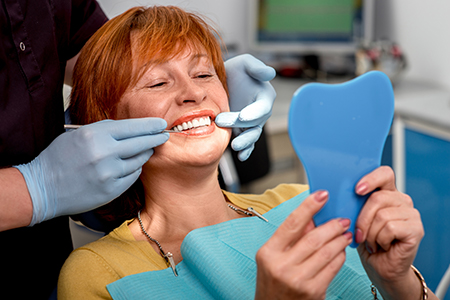
Modern removable prosthetics come in several forms to address a wide range of restorative goals. The two primary categories are full (complete) dentures and partial dentures. Within these groups there are variations designed to improve comfort, stability, and function depending on a patient’s oral condition.
Full dentures replace all teeth in an arch and are shaped to fit the contours of the gums and underlying bone. Partial dentures fill the spaces left by one or more missing teeth and use adjacent natural teeth for support and retention. Both types are crafted to blend with a patient’s remaining dentition and facial features.
When planning which type to use, we evaluate chewing function, remaining tooth stability, gum health, and bite relationships. The design process balances durability with the most natural look and feel possible, and we consider future treatment possibilities — such as implant support — when developing a long-term plan.
Complete dentures can be delivered as conventional prostheses or as forms that provide immediate function after extractions. A conventional complete denture is fabricated after the gums have healed following tooth removal, allowing for a precise fit against stabilized tissues.
Immediate dentures are placed at the same appointment as tooth removal so the patient does not experience a period without teeth. They can require subsequent adjustments or relines as the gums and bone remodel during healing. Immediate prostheses provide continuity of appearance and function while a longer-term solution is finalized.
Overdentures
An overdenture derives extra stability from remaining tooth roots or specially placed attachments. When healthy roots are retained and prepared, they can anchor the prosthesis more securely and help preserve bone beneath the denture.
Implant-retained and implant-supported dentures
Dentures can be designed to connect to dental implants for enhanced retention and confidence during eating and speaking. Implants provide fixed points of support that reduce movement and can improve comfort for long-term wearers.
Partial dentures restore gaps while helping to stabilize the remaining teeth and preserve proper alignment. They commonly use clasps or precision attachments that grip the adjacent teeth, and their frameworks may be crafted from metal, flexible resin, or hybrid materials to balance strength and esthetics.
Because partials work in harmony with natural teeth, the condition and longevity of those teeth are integral to the success of the prosthesis. Regular checkups and careful oral hygiene help extend the life of both the partial denture and the supporting teeth.
Our approach is to recommend the most conservative design that delivers reliable function and a pleasing appearance while keeping future treatment options open when appropriate.
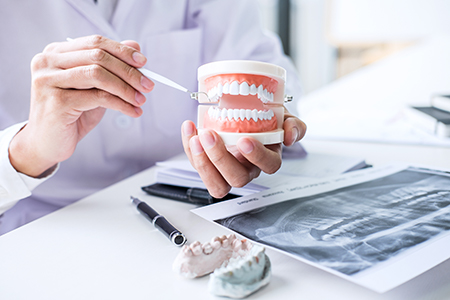
A well-fitting denture begins with a thorough evaluation. We review medical and dental history, perform a clinical exam, and use diagnostic imaging when needed to assess bone levels and the condition of remaining teeth. These steps guide treatment sequencing and identify whether pre-prosthetic procedures or extractions are necessary.
Once a treatment plan is established, impressions and measurements are taken to capture the precise contours of the mouth. Laboratory try-ins and adjustments allow us to verify tooth position, bite relationships, and facial support so the final prosthesis functions comfortably.
Throughout the fabrication process, we prioritize communication and patient education. You’ll be guided through wear schedules, cleaning routines, and what to expect during the initial adaptation period. If additional retention is desired later, we’ll review implant-assisted options or other enhancements that can improve stability.
Delivering a denture often involves a series of appointments so that fit and function can be refined. This staged approach improves the odds of a long-lasting, comfortable result and helps ensure the appliance meets your expectations.

Adapting to a new denture takes time and patience. In the first days or weeks you may notice increased saliva production, mild soreness in areas of pressure, or small changes in speech. These responses are normal as the mouth learns to accommodate the appliance.
To speed adaptation, practice speaking aloud and begin with softer foods, chewing slowly and using both sides of the mouth. Follow-up visits are an important part of care so we can make targeted adjustments where needed to relieve sore spots and improve comfort.
Daily care
Rinse and brush dentures daily to remove food and reduce buildup. Use a brush suitable for prosthetics and a recommended soaking solution periodically to keep the appliance fresh and sanitary.
Clean and massage the gums and any remaining teeth to maintain tissue health and circulation. For upper dentures, gentle cleaning of the palate is beneficial as well.
Remove dentures at night to allow tissues to rest and reduce the risk of irritation or infection. Soak them in water or the recommended cleaner when they are not being worn.
When extra stability is needed
Some patients benefit from adhesives or from attaching the denture to implants or specialized attachments for added retention. We’ll discuss options that balance stability with easy removal for hygiene.
Routine follow-up and relines
As jawbone and gum tissues change over time, dentures may require relines or adjustments to maintain fit. Regular dental visits let us monitor oral tissues, check the condition of the prosthesis, and make small corrections before problems arise.
Our team is committed to clear guidance and attentive follow-up so you can enjoy reliable function and comfort with your new denture. If you have questions about how a denture might fit into your overall treatment plan or about long-term options, please get in touch.
At Texas Super Smiles for Kids, we take a thoughtful, patient-centered approach to denture care and long-term oral health. Contact us if you would like more information about denture choices, the treatment process, or what to expect during recovery and maintenance.

Today, it’s easier than ever to replace missing teeth and achieve natural-looking, durable, and long-lasting results! Depending on a patient’s dental needs, lifestyle, expectations of care, and budget, choices can include conventional fixed bridgework, dental implants, or removable partial and complete dentures. At the office of Texas Super Smiles for Kids, we’ll discuss all your options in care and answer all your questions as you choose the solution that’s right for you.
With advances in dental materials and technology, today’s dentures are more comfortable and realistic-looking than ever before.
Whether you wear partial or complete dentures, it’s essential to see the dentist for routine care. Besides checking the fit and condition of your dentures and making any necessary adjustments, you’ll also receive a comprehensive exam to check on the health of any remaining teeth as well as the soft and hard tissues in and around the oral cavity.
A same-day denture offers an accelerated design and fabrication process that allows a patient to go from impression taking to denture insertion in a single day.
For patients who don’t want to wait after having teeth extracted, an immediate denture can be inserted the same day your teeth are removed. Sometime later you may need the denture relined to address any changes in its fit once the extraction sites have completely healed.
While no one wants to drop or break a partial or complete denture, accidents do happen. The good news is that in some cases, your partial or complete denture is reparable. It all depends on the extent of the damage. Don’t hesitate to contact our office if you’ve broken or damaged your denture. We’re happy to help.
The simple act of taking your partial denture in and out can cause certain types of metal clasps to loosen over time. When you come in for your checkup visit or contact our office for an adjustment, we’ll assess the fit of your partial and tighten the clasps for improved stability and comfort.
While rebuilding a complete smile is a worthwhile investment, our office is sensitive to the costs involved in dental care. We customize care and will discuss which treatment options address your needs, lifestyle, and budget. How much a new denture will cost depends on the type of the prosthesis, its design, and the materials used to fabricate the supportive base, teeth, and clasps or precision attachments. Dentures that include the placement of dental implants for added retention and stability typically involve additional costs.
If you have dental insurance, your coverage may include a new or replacement set of dentures. Our staff is happy to review your coverage with you to ensure you are maximizing your insurance benefits while minimizing any out of pocket expenses.
At the office of Texas Super Smiles for Kids, we provide an extensive range of dental services, including the latest and most effective methods to help patients with missing teeth rebuild complete and beautiful smiles. As skilled and experienced professionals, we recognize that every patient is different, and every smile is unique. We’re passionate about what we do and take great pride in providing personalized treatment plans while treating our patients as valued partners in care.